What is ADHD?
ADHD is a lifelong neurodevelopmental condition affecting attention, emotion, motivation, and regulation. It is highly genetic, biologically based, and responds well to treatment. Understanding ADHD as a regulation disorder helps explain fluctuating abilities and lived experience.
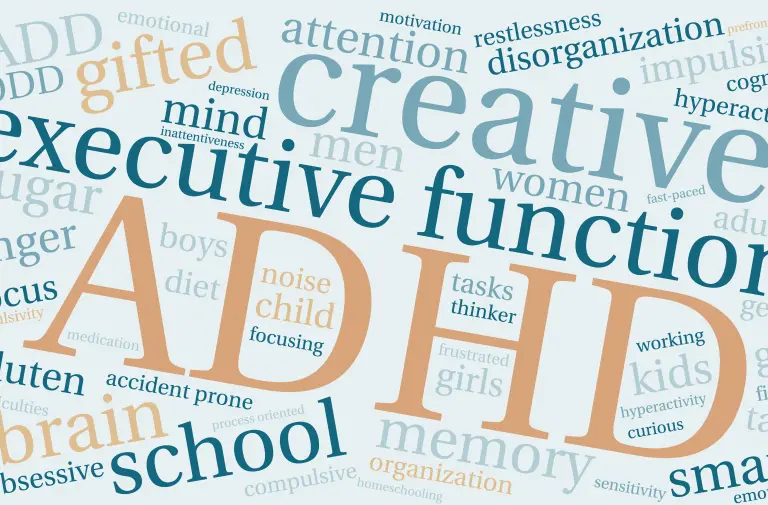
ADHD is a real medical illness — as real as any physical or mental health condition. It has clear diagnostic criteria, a strong research base spanning over 70 years, and well-established, safe, and effective treatments.
Across studies worldwide, ADHD consistently:
- occurs at similar rates across countries and cultures (though detection varies),
- follows a recognisable and consistent pattern of symptoms and behaviours,
- causes impairment in education, work, relationships, and physical health,
- is associated with higher risks of accidents, substance misuse, and justice involvement,
- is linked to measurable brain differences that improve with treatment,
- has one of the strongest genetic bases among mental health conditions,
- responds extremely well to appropriate treatment,
- and has had stable diagnostic criteria across international guidelines for over 50 years.
For all these reasons, ADHD is as real and valid as any physical or mental illness.
Personality describes the relatively stable ways we think, feel, and behave across situations.
In everyday language, people often describe personality using simple labels such as: “he is kind,” “she has a temper,” “he is a perfectionist.” These descriptions are based on other people’s views and interpretations and are therefore subjective, culturally shaped, and often influenced by context and relationships.
Across cultures and throughout history, humans have tried to make sense of these differences by developing systems to describe personality. In the last 100–150 years, mental health professionals have attempted to formalise these ideas using psychological models.
The most widely accepted and scientifically supported framework today is the Big Five (Five-Factor Model) of personality. This model has the strongest empirical and genetic evidence among personality theories. Rather than placing people into rigid categories or “types,” it describes personality as dimensional.
Each trait exists on a spectrum. For example, a person may fall anywhere from extremely introverted, to slightly introverted, to neutral, to slightly extroverted, and finally to extremely extroverted. Most people have all five traits, but in different degrees of severity, which together make up the whole person.
The Big Five Personality Traits

Traditionally, personality traits were thought to develop mainly during the first two decades of life and then remain relatively fixed. While modern research shows that gradual change continues across adulthood, personality frameworks are primarily descriptive and theoretical. Even well-validated models such as the Big Five do not describe disease states; rather, they summarise patterns of behaviour and temperament. That said, the traits described within the Big Five framework do show heritability and tend to cluster within families, supporting a biological contribution without implying pathology.
However, as one can see in the above chart, several “personality traits” — such as impulsivity, emotional reactivity, disorganisation, novelty-seeking, or restlessness — overlap closely with what we now recognise as core features of lifelong ADHD.
Unlike personality descriptions, which are descriptive and applied from adulthood, ADHD is present from early life, is highly genetic, is associated with consistent brain differences, and is evident across settings and time. Logically, ADHD should be considered first in people who present with these lifelong patterns before attributing them to personality.
This also explains why people are often described as having been “always like this” — impulsive at school, emotionally intense in relationships, disorganised at work, yet creative, energetic, and engaging — long before ADHD is considered.
ADHD Features Commonly Mistaken for Personality Traits
| ADHD feature | Commonly mislabelled as |
|---|---|
| Impulsivity | “Reckless” or “irresponsible personality” |
| Emotional reactivity | “Dramatic”, “moody”, or “unstable” |
| Disorganisation | “Lazy” or “careless” |
| Novelty-seeking | “Unreliable” or “commitment-phobic” |
| Restlessness | “Anxious” or “hyper” |
| Inconsistent performance | “Not trying” or “lacks discipline” |
Qualities such as creativity, intelligence, humour, empathy, passion, values, and athletic ability uniquely belong to personality. These traits are not ADHD symptoms and are not commonly confused with ADHD. They remain stable, including with treatment.
A common fear is that treatment of ADHD will “change who I am.” In practice:
- emotional extremes soften rather than disappear,
- experiences become more predictable (which can initially feel unfamiliar),
- core personality traits remain intact,
- small changes often lead to disproportionately large improvements in functioning.
Many people describe feeling “more themselves, more of the time.” They still experience enthusiasm, emotion, creativity, and drive — but without the same degree of chaos, exhaustion, or self-blame.
Terms such as syndrome, disorder, disease, and illness reflect stages of medical understanding rather than seriousness. Crucially, this process begins with lived human experience.
A Continuum: From Human Experience to Disease
1. Human Experience (Illness)
Every condition starts with lived experience before it has a name or diagnosis. For ADHD, this might include:
- lifelong distractibility or mental restlessness,
- emotional intensity or volatility,
- chronic underachievement despite effort,
- difficulty sustaining motivation for everyday tasks.
At this stage, there is no diagnosis — only personal meaning shaped by culture, family narratives, self-esteem, and repeated feedback from others.
2. Symptoms That Cluster → Syndrome
When experiences consistently cluster together, clinicians recognise a syndrome — describing what is happening, even if the underlying mechanism is not fully understood.
Examples include:
- chronic fatigue syndrome,
- irritable bowel syndrome,
- early descriptions of ADHD and autism.
In ADHD, early clinicians noticed recurring patterns of hyperactivity, impulsivity, and poor regulation, even when no obvious brain injury was present.
3. Functional Impact → Disorder
When these symptom clusters cause sustained impairment in daily functioning, they are classified as disorders.
Examples include:
- ADHD,
- major depressive disorder,
- generalised anxiety disorder.
At this stage, ADHD was recognised as a condition that:
- begins early,
- persists over time,
- affects education, work, relationships, health, and self-esteem.
Most mental health conditions sit at this level because they involve complex system dysregulation rather than a single identifiable lesion.
4. Identified Mechanism → Disease
When a clear biological mechanism or pathology is identified, conditions may be classified as diseases.
Examples include:
- Parkinson’s disease,
- Alzheimer’s disease,
- multiple sclerosis.
Many conditions once considered psychological have moved into this category as science has advanced.
ADHD illustrates this progression clearly.
- 1930s–1940s: Clinicians observed children who developed hyperactivity and poor self-regulation following encephalitis.
- 1950s–1960s: Similar behavioural patterns were recognised in children without brain injury, leading to descriptions such as hyperkinetic syndrome, with attention later recognised as central.
- 1970s onwards: Longitudinal studies demonstrated that these patterns:
- begin early,
- persist into adulthood,
- and cause significant impairment across multiple life domains.
ADHD was therefore classified as a neurodevelopmental disorder, reflecting dysregulation of attention, executive function, motivation, and emotional control.
ADHD is not currently classified as a disease because no single biomarker or lesion explains it. This reflects biological complexity — not doubt about its legitimacy.
ADHD is best understood through three complementary lenses.
1. ADHD as a Neurodevelopmental Disorder
ADHD begins in childhood and reflects differences in brain development affecting:
- attention regulation,
- planning and organisation,
- impulse control,
- emotional regulation.
These differences persist into adulthood, even if outward hyperactivity reduces.
2. ADHD as Part of Neurodiversity
The concept of neurodiversity recognises natural variation in how human brains function. It was introduced to reduce stigma and promote acceptance, particularly for conditions without specific medical treatments.
ADHD fits within this framework but is unique in having highly effective, evidence-based medical treatments.
The neurodiversity lens helps people recognise strengths often associated with ADHD — creativity, energy, enthusiasm, rapid problem-solving. However, overemphasising acceptance without treatment can unintentionally minimise the importance of assessment when symptoms are significantly impairing.
Acceptance and treatment are not opposites. Both are essential.
3. ADHD as a Mental Illness
There is no single agreed definition of mental illness. Traditionally, the term described disorders of mood, thought, and perception — such as depression, anxiety disorders, bipolar disorder, and schizophrenia — particularly where there were no clear structural brain changes.
This logic was never applied consistently. Dementia, for example, has clear brain pathology yet has always been classified as a mental illness within mental health legislation.
ADHD was initially viewed as a childhood condition. Even as adult ADHD became recognised, it was often framed as a cognitive or behavioural issue rather than a mental illness. Neurologists did not take ownership because ADHD does not produce obvious focal neurological signs. Adult psychiatrists and mental health teams also historically did not recognise or accept ADHD as part of mainstream mental illness.
As a result, ADHD existed in a “no man’s land” between specialties for many years — a key reason for its under-recognition in adults.
We now understand that emotional dysregulation and sleep disturbance are core features of ADHD, and that ADHD affects multiple mental domains, including attention, emotions, behaviour, memory, and decision-making. On this basis, ADHD clearly meets reasonable definitions of a mental illness and logically belongs within mental health services — even if service structures have not fully caught up.
Clinically, ADHD is defined by 18 symptoms, but these are best understood as part of a broader regulation difficulty.
ADHD affects five interacting domains:
- executive function,
- attention and cognition,
- emotional regulation,
- motivation and reward,
- behaviour and impulse control.
All of these are coordinated by the prefrontal cortex, which acts as the brain’s regulator. In ADHD, dopamine signalling fluctuates unpredictably. The result is not a lack of ability, but unreliable access to ability.
This explains everyday experiences such as:
- “Some days I can do everything, and other days nothing.”
- “I know what to do, but I can’t make myself start.”
- “I care deeply, but my brain won’t engage.”
In ADHD, internal systems often fail to synchronise.
People may experience:
- good mood but very low energy,
- anxiety before a social event, excitement during it, and a sharp crash afterwards,
- mental overstimulation with physical exhaustion,
- strong intentions but overwhelm the moment a task begins.
People often say:
- “My mind and body are on different settings.”
- “I’m excited and bored at the same time.”
- “I want to do it, but I can’t access the energy.”
These are biological regulation patterns, not personality flaws.
Because mood, motivation, anxiety, energy, and focus can shift independently and often to extremes, many people describe living in separate internal “bubbles” — excitement, worry, hyperfocus, boredom, shutdown — with little time spent in a balanced middle state.
Inside each bubble, it can feel hard to emotionally remember the others. Over time, this can lead to:
- a fragmented sense of identity,
- inner emptiness,
- imposter syndrome — feeling capable in some moments and fraudulent in others.
This is not dissociation. It reflects the ADHD brain rapidly flipping between regulatory states.
Effective treatment helps the regulator work more consistently.
Rather than flattening emotion or personality, treatment:
- reduces extremes,
- improves transitions between states,
- increases time spent in a regulated middle ground,
- aligns emotion, motivation, energy, and focus.
The goal is not to change who someone is — but to allow who they are to show up consistently.